


Written by Dr. Juan Carlos Pérez
Dr. Juan Carlos Pérez Rodríguez
Spine Neurosurgeon | Co-author of Research Published in Brain and Spine (EANS), 2026
SpineAx — Specialized Spine Surgery,
Neurosurgery, and Comprehensive Back Pain Care
Bogotá, Colombia
Medical content focused on spinal injections, lower back pain, sciatica, and the importance of individualized evaluation before considering minimally invasive spine procedures.
Is persistent back pain making it harder to enjoy your daily life in Bogotá? Whether you’re dealing with lower back pain, sciatica, or discomfort that travels down your legs, even simple activities like walking, sitting, or working can become a challenge. The good news is that surgery isn’t always necessary. Spinal Injections are a minimally invasive treatment option that may help reduce inflammation, relieve certain types of pain, and improve mobility when recommended after a thorough medical evaluation.
At SpineAx, we understand how frustrating it can be to deal with back pain, especially when you’re living abroad and need medical care you can trust. Our team of spine specialists and neurosurgeons in Bogotá focuses on identifying the source of your symptoms and helping you explore the most appropriate treatment options. If you’re already living in or staying in Colombia, we’re here to help you understand whether Spinal Injections in Bogotá could be the right next step toward feeling better and getting back to your routine.
Your Spine Health Deserves Specialized Care
Whether you're experiencing persistent back pain, dealing with a complex spinal condition, or looking for a second medical opinion, you don't have to face it alone. At SpineAx, our team of spine specialists and neurosurgeons is here to understand your condition, answer your questions, and guide you toward the most appropriate treatment options.
Book Your Spine Consultation
What Are Spinal Injections and How Can They Help Relieve Back Pain?
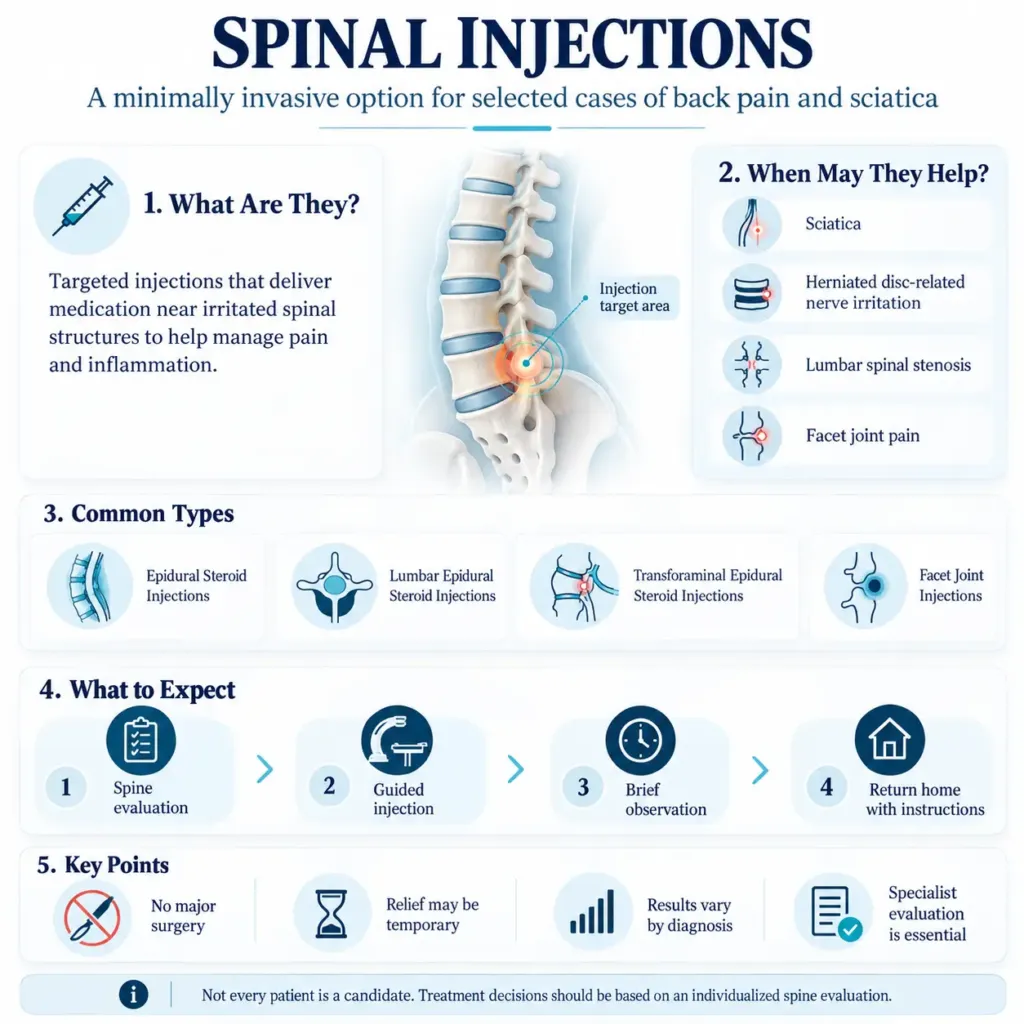
Spinal Injections are minimally invasive procedures that deliver medication to specific areas of the spine to help manage pain associated with inflammation or irritated nerves and joints. Depending on the diagnosis, these injections may contain corticosteroids, local anesthetics, or a combination of medications.
Unlike surgery, spinal injections do not require large incisions or structural changes to the spine. Their primary goal is to reduce certain types of pain, improve comfort, and help patients return to their daily activities. However, not every back condition responds to injections, which is why identifying the source of pain is essential before recommending treatment.
How Spinal Injections Target Inflammation and Pain Near the Spine
When a spinal nerve becomes irritated or a joint develops inflammation, pain can extend beyond the lower back, sometimes reaching the buttocks or legs. Spinal Steroid Injections may help by delivering anti-inflammatory medication close to the affected structures, reducing inflammation and easing symptoms in appropriately selected patients.
How spinal injections may help
Targeted Medication
Delivered near the affected area
Inflammation Control
May reduce irritation and pain
Improved Function
May make movement and rehabilitation easier
At SpineAx, we focus on understanding what’s causing your symptoms before considering an injection. Relieving inflammation can be helpful, but it doesn’t necessarily correct the underlying condition, such as a herniated disc or spinal narrowing.
Types of Spinal Injections: Understanding the Different Treatment Options
Not all Back Pain Injections work in the same way. The appropriate technique depends on whether the pain originates from an irritated spinal nerve, an inflamed joint, or another structure.
Here are some of the main procedures patients may encounter:
| Type of injection | Where it is administered | Main purpose |
|---|---|---|
| Epidural Steroid Injections | Epidural space surrounding spinal nerve structures | Help reduce inflammation associated with certain types of nerve-related pain |
| Lumbar Epidural Steroid Injections | Epidural space in the lower back | Manage selected cases of lumbar radicular pain, including sciatica |
| Transforaminal Epidural Steroid Injections | Epidural space approached through the opening where a spinal nerve exits | Deliver medication near a specific irritated nerve root |
| Facet Joint Injections | Into or around the small joints connecting the vertebrae | Evaluate or help manage pain suspected to originate from facet joints |
Epidural Steroid Injections
Where it is administered
Epidural space surrounding spinal nerve structures
Main purpose
Help reduce inflammation associated with certain types of nerve-related pain
Lumbar Epidural Steroid Injections
Where it is administered
Epidural space in the lower back
Main purpose
Manage selected cases of lumbar radicular pain, including sciatica
Transforaminal Epidural Steroid Injections
Where it is administered
Epidural space approached through the opening where a spinal nerve exits
Main purpose
Deliver medication near a specific irritated nerve root
Facet Joint Injections
Where it is administered
Into or around the small joints connecting the vertebrae
Main purpose
Evaluate or help manage pain suspected to originate from facet joints
These techniques have different targets and indications. A lumbar epidural injection is a location-specific form of epidural injection, while the transforaminal approach describes a particular route of administration.
The most important question isn’t which injection is best overall, but which treatment is appropriate for your diagnosis. At SpineAx, our priority is to evaluate your condition and explain the available options before considering an intervention.
Can Spinal Injections Help You Avoid Surgery for Back Pain?
If you’re concerned about needing spine surgery, it’s worth knowing that some conditions can initially be managed without an operation. For selected patients, Lumbar Injections may be part of a broader treatment plan that includes physical therapy, medication, and activity adjustments.
When an injection provides sufficient relief, it may create an opportunity to participate more comfortably in rehabilitation and regain daily function. However, pain relief is often temporary, and spinal injections cannot guarantee that surgery will be avoided.
When is a specialist evaluation especially important?
A consultation can help determine whether conservative treatment remains appropriate or whether another approach is needed. Progressive neurological weakness or other serious warning signs may require urgent assessment rather than an injection.
At SpineAx, we believe the best treatment begins with an accurate diagnosis, not an assumption that every patient need surgery. If you’re already in Bogotá and struggling with persistent back pain, our spine specialists can evaluate your symptoms and help you understand whether Spinal Injections are a suitable option for your condition.
When Are Spinal Injections Recommended for Lower Back Pain and Sciatica?
Not every type of back pain requires the same treatment. Spinal Injections may be recommended when symptoms are associated with irritated nerve roots or specific spinal joints, particularly when medications, physical therapy, or other conservative treatments haven’t provided enough relief.
At SpineAx, we believe that understanding where your pain comes from is essential. The following conditions are among those for which certain types of spinal injections may be considered after a specialist evaluation.
Sciatica and Lumbar Radiculopathy: When Pain Travels from Your Back to Your Leg
Does your pain start in your lower back and travel through your buttock into one leg? You may be experiencing sciatica or lumbar radiculopathy; conditions commonly associated with irritation or compression of spinal nerve roots.
Symptoms may include shooting pain, burning sensations, tingling, or numbness. When inflammation contributes to these symptoms, Spinal Steroid Injections may help reduce nerve irritation and provide temporary relief, particularly when leg pain is a prominent symptom.
Herniated Discs: Can Spinal Injections Relieve Nerve Irritation?
A herniated disc occurs when part of a spinal disc pushes beyond its usual boundaries. If this material irritates or compresses a nearby nerve, it can cause pain that radiates into the leg.
In selected cases, Epidural Steroid Injections may reduce inflammation around the affected nerve and make daily movement more comfortable.
However, these injections don’t remove the herniated disc or repair its structure. Their purpose is to help manage symptoms while the underlying condition is monitored and treated appropriately.
Lumbar Spinal Stenosis: Managing Pain That Affects Walking and Daily Activities
If your legs become painful, heavy, or uncomfortable while standing or walking, but feel better when you sit or lean forward, lumbar spinal stenosis may be one possible explanation.
This condition involves narrowing of spaces within the spine, potentially affecting nearby nerves. Depending on the symptoms and clinical findings, Lumbar Epidural Steroid Injections may be considered to manage certain nerve-related symptoms.
It’s important to understand that injections cannot widen the spinal canal or reverse the narrowing. The degree and duration of improvement vary, and some patients may benefit little or not at all.
Facet Joint Pain: When Lower Back Discomfort Comes from the Spinal Joints
Not all lower back pain originates from a disc or nerve. Sometimes, the small joints connecting the vertebrae, known as facet joints, may contribute to discomfort.
Facet-related pain is often felt in the lower back and may worsen with certain movements, particularly bending backward or twisting.
For carefully selected patients, Facet Joint Injections may be considered as part of the evaluation or management of suspected joint-related pain. Their therapeutic benefit is variable, and symptoms alone cannot reliably confirm that these joints are the source of pain.
Persistent Lower Back Pain: How to Know if Lumbar Injections Are Right for You
Living with chronic lower back pain can affect your sleep, productivity, and ability to enjoy everyday activities. But persistent pain doesn’t automatically mean that an injection will help.
Before recommending Lumbar Injections, we need to consider the underlying diagnosis, your symptoms, previous treatments, and whether there is a clear structure that could benefit from targeted medication.
Could your symptoms benefit from a spinal injection?
This overview helps explain why different symptoms require different evaluations. It is not a diagnosis.
| Symptoms or condition | What a specialist may evaluate |
|---|---|
|
Pain radiating down one leg
|
Nerve root irritation or sciatica |
|
Leg pain associated with a herniated disc
|
Inflammation around an affected nerve |
|
Leg discomfort when walking or standing
|
Possible lumbar spinal stenosis |
|
Localized lower back pain with certain movements
|
Possible facet joint or other musculoskeletal sources |
|
Persistent pain without a clear cause
|
Further assessment before choosing treatment |
Nerve root irritation or sciatica
Inflammation around an affected nerve
Possible lumbar spinal stenosis
Possible facet joint or other musculoskeletal sources
Further assessment before choosing treatment
At SpineAx, our goal is to help you understand your diagnosis and determine whether an injection is worth considering. The right treatment starts with identifying the source of your pain, not simply choosing a procedure.
Don't Let Back Pain Keep You From Enjoying Your Life in Bogotá.
What to Expect Before, During and After Spinal Injections
If you’re considering Spinal Injections, it’s natural to have questions: Will the procedure hurt? How long will it take? Can you walk afterward? And, most importantly, when might you start feeling better?
These procedures are generally less invasive than spine surgery, but they still require careful planning, appropriate technique, and individualized medical guidance.
Your First Spine Evaluation: Finding the Cause of Your Pain Before Treatment
Before recommending an injection, our priority at SpineAx is to understand your condition and determine whether this treatment is appropriate.
A specialized evaluation generally includes reviewing your symptoms, medical history, and previous treatments, along with a physical and neurological examination. We may also review existing MRI or other imaging studies or recommend additional tests when clinically necessary.
- ✓ Your symptoms and pain patterns
- ✓ Medical history and previous treatments
- ✓ Physical and neurological examination
- ✓ Imaging studies when clinically indicated
- ✓ Previous MRI, CT, or X-ray images and reports
- ✓ Medication list, especially blood thinners
- ✓ Information about allergies, diabetes, infections, and previous spine procedures
- ✓ Details about where your pain starts, spreads, and what makes it better or worse
Why it matters: This information helps us assess the potential benefits and risks and discuss whether Back Pain Injections may be suitable for your situation.
How Are Spinal Injections Performed, and Will the Procedure Hurt?
Most Spinal Injections are performed without a large surgical incision. The exact technique depends on the type of injection and the area being treated.
What Usually Happens During the Procedure?You'll be positioned for the procedure, often lying face down. The skin is cleaned and the area prepared.
A local anesthetic may numb the skin. You may feel a brief pinch or stinging sensation.
Imaging, such as fluoroscopy, may guide needle placement. Contrast may also be used when appropriate.
Medication is administered at the intended location. Temporary pressure or tingling may occur.
You'll be monitored for immediate reactions before receiving instructions for going home.
Will it hurt? Most patients experience some discomfort rather than severe pain, although individual experiences vary. Tell the medical team immediately if you experience intense or unusual pain.
Are Spinal Injections Safe? Understanding Possible Risks and Side Effects
Spinal Injections are generally considered minimally invasive procedures, but like any medical intervention, they carry risks. Safety depends on the technique, the patient's health, medications, and the professional performing the procedure.
Most reported side effects are temporary, although serious complications are possible.
| Possible Side Effect or Complication | What You Should Know |
|---|---|
| Temporary soreness | Mild tenderness, bruising, or discomfort around the injection site may occur. |
| Temporary increase in pain | Some patients experience increased discomfort during the first few days before improvement. |
| Medication-related reactions | Corticosteroids may temporarily raise blood sugar, particularly in patients with diabetes. |
| Infection or bleeding | These are uncommon but important risks requiring appropriate precautions. |
| Nerve injury or neurological complications | Rare but potentially serious complications can occur, particularly with epidural procedures. |
Mild tenderness, bruising, or discomfort around the injection site.
Pain may temporarily worsen during the first few days.
Corticosteroids may temporarily increase blood sugar.
Uncommon complications requiring appropriate precautions.
Rare but potentially serious complications may occur.
Patient Safety Matters. The U.S. FDA has warned about rare but serious neurological complications associated with epidural corticosteroid injections. Discussing potential benefits, alternatives, and individual risks before treatment is essential.
At SpineAx, we emphasize specialized medical evaluation and individualized treatment planning to determine whether potential benefits justify the risks. Patients with active infections, certain bleeding disorders, or other relevant medical conditions may need an alternative approach.
How Long Does Pain Relief Last After a Spinal Injection?
One of the most common questions we hear is whether the results will last. The answer depends on the underlying condition, the medication, and how your body responds.
Some patients experience relief for a few days or weeks, while others notice improvement for several months. Some receive little or no meaningful relief.
When Might You Notice Improvement?If a local anesthetic is used, you may notice temporary relief as the medication takes effect.
With certain Epidural Steroid Injections, anti-inflammatory benefits may begin. Temporary soreness may also occur.
Some patients experience sustained improvement, while others may need further assessment or alternative treatment.
A 2025 systematic review from the American Academy of Neurology found that epidural steroid injections probably provide short-term improvements in pain and disability for cervical or lumbar radiculopathy, while evidence for long-term pain relief remains insufficient.
Our Perspective at SpineAx: Success isn't measured only by pain reduction. We also consider whether treatment helps you walk comfortably, participate in rehabilitation, sleep better, and return to meaningful daily activities.
Recovery After Lumbar Injections: When Can You Return to Your Normal Routine?
Recovery from Lumbar Injections is usually shorter than recovery from spine surgery. Many patients can walk shortly after the procedure and return home following observation, provided there are no complications.
However, returning immediately to every activity isn't always recommended.
General Recovery RecommendationsGentle walking, light activities, following medication instructions, and monitoring your symptoms.
Driving for 24 hours when instructed, heavy lifting, strenuous exercise, and repetitive bending or twisting until your medical team clears you.
If you develop fever, a severe or unusual headache, new or worsening leg weakness, or loss of bladder or bowel control after an injection, seek medical care immediately rather than waiting for a follow-up appointment.
At SpineAx, we understand that getting back to your routine matters, whether you're working, studying, or living in Bogotá. Our approach begins with carefully evaluating your condition and discussing what you can realistically expect from treatment. If persistent back pain is limiting your life, contact SpineAx to request a specialized spine evaluation and find out whether Spinal Injections may be right for you.
Why Choose SpineAx for Spinal Injections in Bogotá, Colombia?

At SpineAx, we know that living with persistent back pain can be exhausting, especially when you’re unsure where to turn for help. Our team of spine specialists and neurosurgeons, led by Dr. Juan Carlos Pérez, is dedicated to understanding your symptoms, identifying the source of your discomfort, and helping you find the right path forward. We believe that personalized spine care starts with an accurate diagnosis, which is why we carefully evaluate each patient before recommending Spinal Injections or other treatment options.
If you’re an international patient already living in or staying in Bogotá, you don’t have to navigate your back pain concerns alone. At SpineAx, you can request a specialized spine evaluation in Bogotá and discuss your symptoms with a team experienced in treating spinal conditions. We’re here to help you understand your options and feel more confident about your next steps.
Schedule Your Spine Evaluation with SpineAx and Take the Next Step Toward Relief
Frequently Asked Questions About Spinal Injections in Bogotá
1. Are spinal injections painful?
Most patients experience mild discomfort rather than severe pain during Spinal Injections. A local anesthetic is often used to numb the skin before the procedure, although you may still feel some pressure, a brief pinch, or temporary discomfort as the medication is administered. The experience varies depending on the injection technique and your individual sensitivity. Your medical team can explain what to expect and what measures may help keep you comfortable.
2. How long does a spinal injection procedure take?
The injection itself often takes approximately 15 to 30 minutes, although the duration depends on the type of procedure, the area being treated, and whether imaging guidance is required. You should also allow additional time for preparation and observation afterward. Most spinal injections are performed as outpatient procedures, meaning patients can generally return home the same day when medically appropriate.
3. How soon will I feel relief after spinal injections?
Some patients notice temporary relief within a few hours if a local anesthetic is used. However, when corticosteroids are administered, pain relief may take several days to develop, sometimes up to a week or longer. It’s also possible to experience temporary soreness before symptoms improve. Not everyone responds to treatment, and the degree of relief depends on the underlying spinal condition and the specific injection performed.
4. Can spinal injections help with sciatica and herniated discs?
Yes, certain Epidural Steroid Injections may help patients experiencing sciatica or lumbar radiculopathy associated with a herniated disc. These procedures aim to reduce inflammation around irritated spinal nerves, potentially relieving pain that travels from the lower back into the buttocks or legs. However, injections do not remove or repair a herniated disc. At SpineAx, we evaluate your symptoms and clinical findings to determine whether this treatment may be appropriate.
5. How many spinal injections might I need?
There is no fixed number of Spinal Injections that works for everyone. Some patients experience meaningful improvement after one procedure, while others may require a different treatment strategy. The decision to consider another injection depends on the initial response, the diagnosis, potential risks, and the medication involved. Repeated corticosteroid injections require particular caution, so they should never be scheduled automatically without reassessing their benefits and safety.
6. Can I walk and return to work after a lumbar injection?
Many patients can walk shortly after Lumbar Injections and return to light activities within 24 hours, depending on the procedure and their medical condition. However, strenuous exercise, heavy lifting, and physically demanding work may need to be postponed temporarily. If sedation is used, driving and certain other activities may be restricted. Your specialist will provide individualized recovery instructions based on the technique performed and how you feel afterward.
7. Are spinal injections a permanent solution for lower back pain?
Not necessarily. Spinal Injections are primarily intended to manage certain types of pain and inflammation rather than permanently correct structural spinal conditions. Some patients experience relief lasting weeks or months, while others notice limited improvement. When successful, injections may make rehabilitation and daily activities more manageable. The long-term treatment plan should address the underlying cause of pain rather than relying exclusively on injections.
8. What are the risks and side effects of spinal steroid injections?
Possible side effects of Spinal Steroid Injections include temporary soreness, increased pain, bruising, and short-term elevations in blood sugar. Less common but more serious complications can include infection, bleeding, nerve injury, or neurological problems. Certain health conditions and medications can increase procedural risks. That’s why a thorough medical evaluation is essential to determine whether the expected benefits outweigh the potential complications.
9. Are spinal injections better than surgery for back pain?
Spinal Injections and spine surgery serve different purposes, so one is not automatically better than the other. Injections may help manage inflammation and pain without changing the structure of the spine, while surgery may be necessary for certain conditions involving significant nerve compression, progressive neurological deficits, or other structural problems. At SpineAx, we focus on identifying the cause of your symptoms and recommending an appropriate treatment strategy rather than assuming every patient needs surgery.
10. Can foreign patients already in Bogotá schedule a consultation for spinal injections at SpineAx?
Yes. If you’re an international patient currently living in or staying in Colombia, you can request a specialized spine evaluation at SpineAx in Bogotá. Our team of spine specialists and neurosurgeons can assess your symptoms, review relevant medical records, and help you understand which treatment options may be suitable for your condition. If you’re experiencing persistent lower back pain, sciatica, or other spinal symptoms, contact SpineAx to schedule your consultation and find out whether Spinal Injections in Bogotá may be an appropriate option for you.

